


World of Illiria
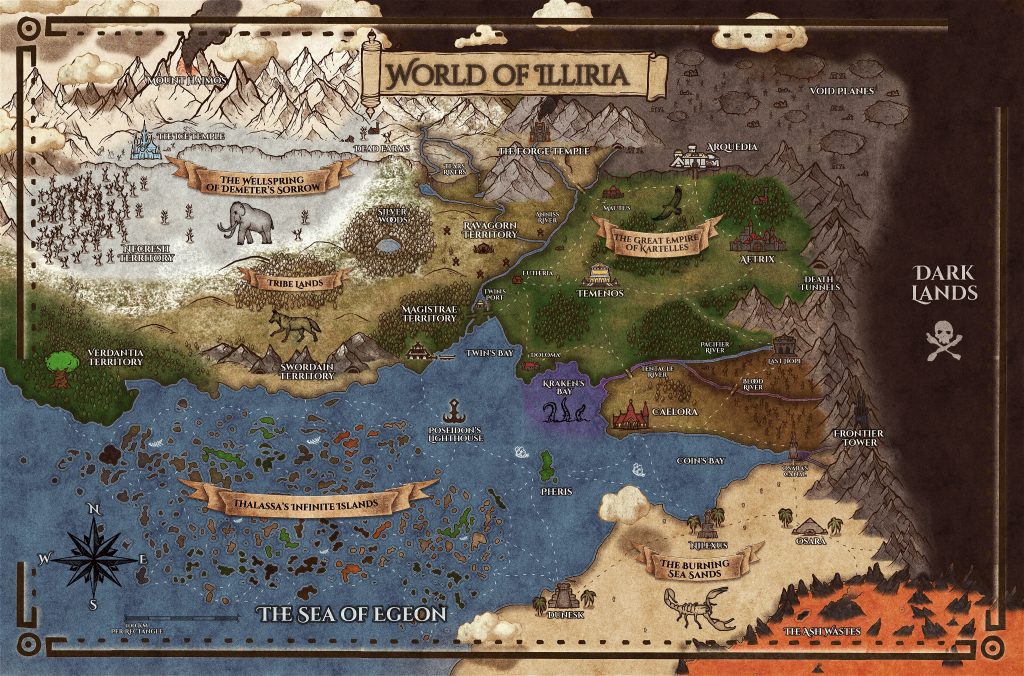
Illiria is a land shrouded in mystery, filled with ruins and danger. A catastrophic event, known as the dark honeymoon, decimated nearly all life, leaving only a handful to rebuild their world from the ashes.
Despite the devastation and tales of lost potential, there is still hope and determination against all odds abounding in every corner of this world. The Game Master, along with the players, will unravel these tales, each of which holds the promise of adventure and discovery.
Contents
The Age of Myths
Before time itself, before the world took form and the stars were kindled in the heavens, there existed only Chaos. This was the primordial void, a boundless and formless expanse where the seeds of creation slumbered, awaiting their awakening. From this abyss emerged the first beings of unimaginable power—the Primordials, who would lay the foundations of the cosmos and sow the seeds of destiny.
The Creation Myth
From Chaos, the first entities emerged: Gaia, the Mother Earth, who would become the nurturing mother of all life; Uranus, the Sky, who stretched above her and encompassed the heavens; Tartarus, the Underworld itself; Thalassa, the Sea Mother, who is the embodiment of all existing water in the world; Nyx, the Night, a shadowy veil that cloaked the world in darkness; and Erebus, the deep Darkness itself. These were the primal forces, the bedrock upon which existence would be built.
Gaia, in her vastness, gave birth to the mountains and lands. In her union with Uranus, she birthed a lineage of powerful beings—the Titans, the Cyclopians, and the Hecatoncheires, the hundred-handed giants. Yet Uranus, fearing the potential of his children, grew tyrannical. He loathed the Cyclopians and the Hecatoncheires for being diferent, so much so that he imprisoned them deep within Tartarus, causing her great pain and sorrow. Desperate to end Uranus’s reign of terror, Gaia devised a plan to overthrow him.
She crafted a great sickle of adamant and called upon her children to aid her in this rebellion. Yet, it was only Cronus, the youngest and most ambitious of the Titans, who had the courage to rise against his father. Gaia hid Cronus within her womb, and when Uranus descended to lay with her, Cronus struck. With a swift and brutal stroke, Cronus castrated Uranus, casting his severed genitals into the sea. From the blood that spilled upon the earth, the Giants were born—beings of pure hatred and power destined to challenge the gods. And from the foam of the sea where Uranus’s genitals fell, Aphrodite, the goddess of love and beauty, arose, her birth heralding a new force in the cosmos.
The Titanomachy
With Uranus overthrown, Cronus ascended to the throne of the cosmos. But like his father before him, Cronus was consumed by the fear of losing his power. He became a tyrant, ruling with an iron fist and paranoia that would be his undoing. It was prophesied that one of his children would rise up to overthrow him, just as he had overthrown Uranus. To prevent this, Cronus devoured each of his children as soon as they were born, swallowing them whole.
But Rhea, his wife, could not bear to lose all her children. When her youngest son, Zeus, was born, she devised a plan to save him. Rhea concealed the infant Zeus, entrusting him to the care of Gaia, who nurtured and raised him in secret. In place of the child, Rhea gave Cronus a stone wrapped in swaddling clothes, which he swallowed without suspicion.
Zeus grew strong, wise, and just under Gaia’s tutelage, and when the time was right, he returned to challenge his father. With the help of Metis, a Titaness known for her cunning, Zeus tricked Cronus into drinking a potion that caused him to vomit up Zeus’s siblings—Hestia, Demeter, Hera, Hades, and Poseidon. Together, they freed the Cyclopian and the Hecatoncheires from their imprisonment in Tartarus, winning their allegiance in the coming war.
The battle that followed, known as the Titanomachy, raged for eons. The Titans, led by Cronus, fought fiercely against Zeus and his allies. The earth shook, the seas boiled, and the heavens were torn asunder in the clash of these mighty forces. In the end, Zeus and his siblings emerged victorious. Cronus and the defeated Titans were cast down into the abyss of Tartarus, a prison deep beneath the earth, where they would languish for all eternity.
Yet, Zeus’s victory was not as merciful as Gaia had hoped. He showed no leniency to the defeated Titans, imprisoning them just as harshly as Cronus had done. This harsh judgment angered Gaia, who had hoped for a more just and compassionate ruler. Her disappointment would sow the seeds for a great conflict that would threaten the gods’ dominion.
The Myth of Prometheus
Before the world trembled under the weight of the Titanomachy, when the Titans still ruled the heavens and the earth, Prometheus and his brothers—Atlas, Epimetheus, and Menoetius—crafted mortals from the raw, untamed essence of the world. Each brother, with his own vision, bestowed upon these fragile beings a gift, shaping them into the creatures that would one day defy the gods themselves.
Atlas, the first to step forward, gave the mortals resilience—the strength to stand tall and bear the crushing weight of the world upon their shoulders, just as he would later carry the heavens on his own. Epimetheus, ever the sculptor, saw the mortals had strange boneless forms, so he molded their flesh from clay, imbuing them with unique forms and features. But Menoetius, seeing their bodies cold and lifeless, gave them a heart full of passion and rage, ensuring that no mortal would ever walk the earth without emotions.
Then came Prometheus, the most foresighted of the brothers, who gazed upon these creatures with a deeper understanding. He saw in them a spark, a potential waiting to be kindled. And so, with a daring hand, he gifted them the divine intellect, embodied in the form of fire—a flame that would illuminate the darkness of ignorance and give birth to civilization and culture.
The four brothers created multiple mortal races. First were the Humans, with their great adapdability, then the Orcs, with their ferocious might, the dwarfs with their craftmanship and resilience, and many more to make the world more interesting.
The Theft of the Flame
Not all Titans were condemned to the abyss of Tartarus after the Titanomachy. Those who sided with Zeus, like Prometheus and Epimetheus, were spared the eternal darkness. Yet, Zeus, with his thunderous pride, looked upon their creation with disdain. How could such weak and ephemeral beings carry the divine flame, the very essence of intellect and creation? To him, the mortals were an insult to the gods, a fragile and unworthy vessel, and they would surely destroy themselves with such power. In his arrogance, Zeus stripped the mortals of their fire, leaving them in the cold darkness of ignorance once more.
Prometheus, however, was not a Titan to bend easily to the will of the Olympian king. Fury burned within him at Zeus’s hubris. He saw the act as an affront to his creation. In a defiant act that would echo through eternity, Prometheus stole the flames from Olympus and returned them to the mortals, rekindling the light of knowledge.
When Zeus discovered this treachery, his wrath was boundless. He chained Prometheus to a desolate mountain, where each night a relentless Phoenix descended upon him, tearing at his liver. And every day, his body would heal, only for the Phoenix to return, devouring him again and again—an endless cycle of torment, a punishment without end.
The Birth of Pandora
But Zeus’s vengeance was not sated by the torment of Prometheus alone. His fury extended to the very mortals who dared to hold the divine flame. With the aid of Hephaestus, Zeus devised a crueler punishment, one that would curse not only Prometheus but the mortals he had sought to elevate.
From the divine forge emerged the Elves, a new race of mortals, and among them, the first and fairest was Pandora. She was sculpted with the beauty of Aphrodite, but the gods each imbued her with gifts, crafting her to be as cunning as she was graceful. Yet, it was Hermes who bestowed upon her the most perilous gift of all—curiosity, the trait that would lead to her undoing.
Zeus, with a deceptive smile, presented the Elves to Epimetheus as a gesture of goodwill, claiming to hold no ill will after Prometheus’s defiance. Epimetheus, captivated by their grace and intellect, accepted them eagerly, and soon he fell deeply in love with Pandora, taking her as his bride.
The Box
As a wedding gift, Hermes gave a box to Pandora, its contents never to be unleashed. But as the days turned to weeks, the weeks to years, and the years into centuries, Pandora’s curiosity gnawed at her, a relentless itch she could not ignore. She opened it, just for a moment, and in that moment unleashed all the evils that would haunt mortals for eternity.
Plague, War, Famine, and Death spilled forth from the box, spreading like a dark shadow across the land. The world was plunged into apocalypse, and mortals, once united in their shared gift of fire, turned against each other, blaming one another for the calamities that befell them. The very knowledge Prometheus had bestowed became a weapon, and Zeus’s prophecy came to pass as mortals used the divine flame to destroy themselves.
But in the midst of despair, Pandora, wracked with guilt, opened the box one final time. From its depths emerged a single, fragile entity—Hope. It flickered like a dying ember, but its light was enough to give mortals the strength to rebuild, to rise from the ashes of their own ruin.
Many wondered why Hope, of all things, was sealed within that cursed box. Some whispered it was a cruel jest, trapping mortals in an endless cycle of despair and rebirth, much like Prometheus’s eternal torment. Yet others, more loyal to Zeus, saw the unleashed evils as trials, believing that only by conquering these challenges could mortals prove themselves worthy of the divine flame and Hope was given to ensure mortals would not destroy themselves in the process.
The Legacy of Pandora
The opening of Pandora’s box marked the dawn of an age of strife. The Elves, once celebrated as the pinnacle of mortal creation, became the scapegoats for the world’s suffering. Racial wars erupted, and these conflicts would rage for centuries, culminating in the Age of Yesterday, a time of unprecedented bloodshed and destruction.
It was only during the Dark Honeymoon that the mortals finally set aside their differences. United by Hope, they fought for survival, forging bonds that transcended race and origin.
In the New Age, the lessons of the past linger in the hearts of mortals. No longer do they judge one another by race or birth. Dwarves and Elves, once bitter enemies, now share drinks and stories in the taverns of a world reborn. The scars of the past remain, but so too does the flame of Hope, flickering ever brighter in a world that has learned to rise above its darkest hours.
The First Giants
It is said that the Giants were born when the blood of Uranus rained down upon the Gaia Earth. In the same event, when the sky god severed manhood fell into the churning depths of the sea, Thalassa, the Sea Mother, mistook this gruesome act for an offering made by Uranus, and thus, in turn, gave birth to Aphrodite, the radiant goddess of love and beauty. Some say the two stood in complete contrast to one another. Aphrodite was a being of love, while her Giant brothers were being of pure hatred, both born from the same act.
The first Giants, beings of pure hate and fury, carried immense power. They harbored a deep-seated enmity for both the Titans and Olympian gods alike, seeing them as usurpers of the natural order. The believed that only mother Gaia could be the true ruler of the cosmos.
The Gigantomachy
After the fall of the Titans and the opening of Pandora’s Box, the gods became obsessed by the mortals they once despised. They were amused with the mortals wars, passions and struggle to defy fate. However, this distracted them from hidden forgotten threats…
The Giants saw this as an opportunity to strike at the very heart of Olympus. The divine throne had grown complacent, and in that moment of vulnerability, the Giants seized their chance. They began to steal en masse the sacred cattle of Helios, the Sun, disrupting the very sustenance of the gods. Their audacity knew no bounds, and they even managed to kidnap Hera, the revered Queen of the Gods, casting a shadow of humiliation over Olympus.
Zeus, in his fury, declared war—a war unlike any the heavens or earth had ever witnessed. This was not a mere skirmish of mortals but a cataclysmic clash that shook the foundations of the cosmos. The Great War erupted, and the skies burned with the fires of divine wrath.
Amidst the chaos, Apollo, the god of prophecy, foresaw a grim future for the gods. He proclaimed that victory could not be achieved without the aid of mortals, those fragile yet indomitable beings who walked the earth. And so, the gods turned to their children with mortals, the demigods.
A Battle like no other
Gaia, the Earth Mother, loved her Giant offspring deeply. She could not bear to see them vanquished by the celestial tyrants. In a desperate bid to save them, she rendered the Giants completely immortal while they remained on land. This boon nearly tipped the scales of war in favor of the Giants, for how could the gods defeat foes who could not die?
But cunning Athena, ever wise and strategic, conceived a plan to turn the tide. She realized that the Giants’ newfound immortality was bound to the land itself. Thus, the battlefield must be moved to where the Giants’ invulnerability would falter. The sea became the stage for their final confrontation.
With the help of the demigods and the united might of the gods, they began the arduous task of dragging the Giants to the sea. It was a brutal and bloody endeavor, each slain Giant a testament to the fierce resolve of their attackers.
Thalassa’s Infinite Islands
After their defeat, Aphrodite, the goddess of love, then sought the aid of her mother Thalassa. She convinced her to give the Giants a proper place to rest, since their immortality forbids them to ever enter Tartarus. Thalassa then transformed them into islands dotting the vast Egeon Ocean. Thus, the Giants were given rest, their immense forms turned to stone, their wrath was eased by love. These became known as the Thalassa’s Infinite Islands.
The Modern Giants
Though the first Giants were defeated, their lineage was not entirely eradicated. Many interbred with the mortals, giving rise to the modern Giants who now roam the land.
The first Giants could shapeshift into various forms. They often assumed their colossal forms, but they could also shrink to minuscule sizes to hide. Their progeny, the modern Giants, lack this control over their forms, often growing to enormous sizes only. Despite their considerable power, modern Giants only possess a fraction of their ancestors’ strength and they also lack any immortality. They inherit only a fragment of their predecessors’ pure hatred, so like any mortal, they could be both virtuous or malevolent, and thus were spared by the gods of Olympus.
The Devil Lords
The Gods, drunk on their triumph from the Titanomachy and Gigantomachy, saw themselves as invincible, their dominion over the cosmos unchallenged. It was in this time of overconfidence that a darker threat crept into their realm from the depths of the cosmos: the Devil Lords.
The Devil Lords were spawn of the goddess of discord, Eris, and had long lurked the Underworld, feasting on the fears and nightmares. Their leader, Baal Muloch, a figure of immense dread, sought to exploit the gods’ hubris. With him were other fell beings—Asmodeus, the Prince of Lust; Belial, the Lord of Deceit; and Lilith, the Queen of Shadows. Though way less powerful than the Olympians, they wielded a far more insidious weapon: cunning.
The Olympian Arrogance
The Olympians Gods dismissed the initial signs of the Devil Lords’ emergence. From atop Mount Olympus, they laughed off the threat, considering these infernal beings as mere nuisances compared to the mighty Titans they had just vanquished.
The Devil Lords, recognizing this arrogance, began their campaign of subtle sabotage. They employed succubi to seduce Zeus, inciting Hera’s legendary jealousy. They poisoned Dionysus’s wine, sending him into maddened frenzies that disrupted the harmony of Olympus. They whispered lies into the ears of Ares, stoking his rage and turning him against his fellow gods. They even tempted Aphrodite with false visions of unfaithfulness, sowing discord among her lovers.
Athena’s Vigilance
Amidst the growing chaos, Athena, the goddess of wisdom and war, alone remained unfooled by the Devil Lords’ schemes. Observing the unraveling order, she saw the hidden hand behind their woes. Athena’s sharp mind and unyielding spirit made her impervious to the Devils’ deceit. She began to quietly gather evidence of their manipulations, all the while formulating a plan to counter their insidious threat.
The Clever Trap
Athena knew that direct confrontation would not be enough to defeat these cunning foes. She needed a strategy that would outwit even the most devious of Devils. She called a secret council with the gods and deities she could still trust, revealing the true nature of their plight. With her guidance, they devised a plan to trap the Devil Lords.
Athena crafted a series of contracts and pacts, each tailored to exploit the desires and weaknesses of the Devil Lords. These documents promised great power and influence over the gods but contained hidden clauses that would bind the Devils to the very depths of Tartarus. She carefully leaked these contracts through trusted intermediaries, ensuring they reached the Devil Lords’ hands.
Believing they had outsmarted the gods, the Devil Lords eagerly signed the contracts, each imagining the supremacy they would gain. But as their infernal marks were placed upon the parchment, the hidden magic within the contracts was activated. Chains of Tartarus materialized from the shadows, ensnaring the Devil Lords in unbreakable bonds. Without a battle, they were bound and cast into the depths of Tartarus, where they could never escape.
With the Devil Lords sealed into Tartarus, peace returned to the realms of gods and mortals. However, the Olympians knew that the threat was not entirely vanquished. The Chains of Tartarus held, but the whispers of the Devils could still be heard in the darkest corners of the world.
The Obsession with Pacts
Tricked by Athena, the Devil Lords became obsessed with the very contracts that had led to their downfall. In their dark prison, they studied the magic Athena had used against them, believing that if they could master it, they might outwit her and break free. This obsession with pacts and contracts became their new weapon, a tool they hoped would one day turn the tables and grant them their freedom.
These Devils would start to whisper and make pacts with mortals, slowly expanding their influence and powers in hope that one day, they can scheme their way to Olympus again.
The Demons
Not all fiends signed Athena’s contract. Some were too dumb to write or read, and others were too busy spreading chaos in the world. These fiends are known as Demons, while the ones bounded by Athena’s pact are known as Devils.
A lot of demons are not bound to Tartarus. Instead, they feed from the negative emotions of mortals, and live as parasites in the mortal plane.
Typhon's Rampage
Typhon’s origin is shrouded in the mists of myth and legend. Some whisper that Gaia, the Earth Mother, grew resentful of Zeus after the Titanomachy and Gigantomachy. She had nurtured Zeus, helping him rise to power as a merciful and just ruler. Yet, she watched in dismay as he transformed into a tyrant, no different from Cronos before him, and Uranus before that.
Fury burned within Gaia, so much, that it resonated with all the despair in Tartarus, bringing forth a supreme monster that would shatter the world and cleanse it of its sins. Thus, Typhon was born, a harbinger of chaos and renewal, destined to tear down the old order and begin anew.
Typhon wielded power beyond comprehension. He was a colossus, a nightmarish giant with wings of a dragon, his lower half a writhing mass of serpents. His left arm was an ungodly amalgamation of a thousand ferocious beasts, while from his right, a thousand dragon heads sprouted from his fingertips.
The Battle of Gods and Typhon
The other Olympians came swiftly, but none could stand against the might of the Supreme Monster. Each, in their own way, was broken, cast aside like leaves before a hurricane. The Monster was hurt, but his fury grew. In the end, it was only Zeus who stood alone.
A New Beginning
Yet, despite its dark origins, Demeter chose to nurture the seed. Her hands, skilled in the arts of growth and renewal, tended to it with care and love. From this act, Persephone was born, a being both of beauty and mystery, destined to walk the path between worlds.
The Age of Yesterday
The Age of Yesterday was a time when Illiria shone as a prosperous land, brimming with magic and wonders. Hundreds of advanced civilizations thrived and reached their full potential, harnessing the incredible power of magic.
Magic was abundant, providing the means to ease life’s burdens, from creating sustenance and healing ailments to securing victories for the sake of prosperity. For those who were fortunate enough to live during this era, they inhabited a true utopia. Resources were plentiful, and jobs were a means to bring glory to one’s family name, rather than a necessity for survival.
Now, Illiria is a mere shadow of its former self, and the dream of returning to that wondrous time is but a bittersweet memory, a reminder of what once was and what may never be again.
-Aurelious Dotrus, the Frost Noble
The Olympian Gods back then...
Oh, how I long for the days of old, when the gods graced our lands with their presence. In those days, one could meet a deity face to face! Oh, their power, their majesty, truly divine.
But now, the gods reside in their home at Olympus, far from mortal reach. Only the most deserving may catch but a fleeting glimpse of the divine.
The gods departed to test our independence, to see if we could maintain the world without their intervention. Alas, we proved unworthy of their trust. Despite all their gifts, we failed them, and now suffer the dire consequences of our inadequacy.
-Iphigenia Sanctus, the Dragon Hunter of Yesterday
A Forgotten Time
Much of the Age of Yesterday has been lost to the mists of time, shrouded in myth and mystery. The few remaining dwarves and elves from that era embellish their stories, painting a picture of a golden age, a time when everything seemed better before the Dark Honeymoon.
Yet, the reality of the Age of Yesterday was far grimmer, marked by relentless wars against many now-forgotten nations. Initially, these conflicts were conventional, fought by armies of men wielding swords and riding horses. But as the wars dragged on, the influence of magic and the divine grew increasingly potent. Warriors began to channel lightning with their bare hands, and mythical beasts filled the skies, their riders commanding storms and shadows. These were known as the Great Wars of Yesterday.
As magic spread across the lands, a few brilliant minds emerged, determined to master its secrets. These early arcane scholars and alchemists embarked on a perilous journey of discovery, probing the very fabric of reality. Their experiments led to the creation of powerful new weapons and monstrous beings, forever altering the course of history.
These pioneers of magic, often shunned and feared, discovered ancient tomes and forged new paths in the arcane arts. They learned to manipulate the elements, summon creatures from other realms, and bend time and space to their will. Their achievements were both wondrous and terrifying, giving rise to legends of great wizards, legends like Nero, the Mad Captain Wizard of Dulvia
The Dark Honeymoon
In the annals of Illiria, the Dark Honeymoon is a period shrouded in despair and mystery, a time when the fabric of life itself seemed to unravel. This catastrophic era began with the sudden and inexplicable vanishing of Persephone, the Goddess of Birth and Renewal, and plunged the world into a nightmare from which it has never fully awakened.
The Disappearance of Persephone
The first signs were subtle. Flowers ceased to bloom, and animals no longer mated. The fields, once vibrant with life, turned barren. Farmers found their crops withering, untouched by the goddess’s life-giving touch. Midwives, who once welcomed new lives daily, stood helpless as births ceased altogether. The very air seemed to hold its breath, waiting for an end that never came.
In Olympus, panic spread among the gods. Searches were conducted in every realm, from the highest peaks to the deepest ocean abysses, but Persephone was nowhere to be found. Rumors spread like wildfire. Some whispered that she had been kidnapped, others that she had forsaken her divine duties. The truth was far more disheartening and bizarre: Persephone had descended to Tartarus, and was now married with Hades, the Lord of the Underworld.
The Curse of Undeath
With Persephone’s absence, the cycle of life and death was disrupted. Souls of the dead were trapped within their decaying bodies, unable to move on to the afterlife. The dead began to rise, not as the ethereal spirits of lore, but as grotesque abominations, half-rotted and reeking of decay. At first, their numbers were small, and they seemed harmless—curiosities to be studied rather than threats to be feared. But as the curse spread, the true horror revealed itself.
Villages and towns fell to the undead plague. Entire families were transformed into mindless creatures driven by an insatiable hunger for the living. The land itself turned against its inhabitants. Trees twisted into gnarled mockeries of life, their branches reaching like skeletal hands. Rivers and lakes grew stagnant, their waters fouled by the unholy presence that tainted the very earth.
The undead first appeared in our village, seemingly harmless and in small numbers at first. We couldn’t even imagine the disaster that would follow.
Initially, we suspected that a rogue wizard was practicing forbidden magic in the area. However, despite our best efforts, we found no evidence of a dark ritual. It didn’t take long for us to realize that the situation was far more dire than we could have ever imagined.
I can still recall the moment when the grim reality set in. I was only twelve years old, tending to the farm, when I witnessed a headless chicken rise to its feet. At first, I dismissed it as a strange quirk of nature, but then the cows, pigs, and other livestock followed suit. Soon, it was the elderly, soldiers, and even the deceased who were returning to life as undead abominations.
As the frigid grip of the first winter took hold, we were powerless to stop the relentless onslaught. By the time the snows had thawed, half of us had already fallen to the curse of undeath.
-Old Commoner
The Divine Depression
Demeter, the Goddess of Harvest and Prosperity, plunged into a profound depression upon learning of her daughter’s departure. Her grief manifested in a winter that gripped the land with unyielding ferocity. Crops failed, and starvation became rampant. The cold seeped into the hearts of men, spreading despair and hopelessness.
The Human Struggle
In the towns and cities, scholars and mages sought to understand the curse that had befallen the land. The grand libraries, filled with dust-covered tomes and ancient scrolls, became sanctuaries of desperate hope. Candlelight flickered over yellowed parchments as weary eyes scoured for any hint of a solution, while whispered incantations echoed in the quiet halls, mingling with the scent of old leather and ink.
Among these tireless seekers of knowledge stood Ahirom Necros, a name that would soon carve itself into history with the sharpness of a blade. Ahirom was not just another mage lost in the labyrinth of magical theory; he was a visionary, driven by an unyielding obsession to restore life as it was before. His relentless pursuit of forbidden knowledge led him to the darkest corners of the arcane. Yet, it was this very audacity that birthed a new school of thought: Necromancy.
Necromancy, under Ahirom’s guidance, was not merely about raising the dead. It was an intricate dance with death, a means to harness the very essence of life and decay. The dead were no longer just mourned but repurposed, turned into guardians and laborers, protecting the living from the relentless tide of undeath that threatened to consume all.
Ahirom Necros’ work was controversial, met with both awe and revulsion. Yet, in the end, it was his dark brilliance that helped tip the scales. His school of necromancy became a beacon of hope in those bleak times, a testament to the desperate lengths mortals would go to defy their fate.
The Aftermath
Today, the Dark Honeymoon is remembered as a time of unparalleled suffering and loss. Persephone still spends half of the year in Tartarus, her absence bringing winter’s chill and a reminder of the world’s fractured state. Though the undead plague has diminished, it persists in desolate places, haunting reminders of a time when the natural order was violently upended.
The world has never fully recovered from the Dark Honeymoon. Its scars are deep and indelible, etched into the very fabric of Illiria. Yet, from this darkness, a new resolve emerged among mortals. They learned to rely on their own strength and ingenuity, understanding that even gods could falter and that they must take their fate into their own hands.
The stories of that time are told and retold, not merely as warnings but as testaments to the resilience and fortitude of the human spirit in the face of divine indifference and cosmic chaos. They speak of a time when mortals stood alone against the darkness and found within themselves the power to endure and rebuild.
And so, the Dark Honeymoon remains a somber chapter in the history of Illiria, a period that forever altered its destiny. It serves as a poignant reminder that even in the darkest times, hope and courage can prevail, and that the spirit of resilience can light the way through the deepest shadows.
“Persephone, the Goddess of Birth and Renewal, disappeared without a trace. Without her presence there were no births nor deaths, just decay and rot. The souls of the dead were unable to move on, leaving the world barren and lifeless. As if that wasn’t enough, Demeter, the great Goddess of Harvest, plunged into a deep depression, unleashing a brutal winter upon us.”
“We eventually learned that Persephone had gone to Tartarus to marry Lord Hades, abandoning all her duties. Can you believe that?! We here, rebuilding this broken world, while they were fucking in their honeymoon. Unbelievable!”
“To this day, Persephone still spends half of the year in Tartarus, which is why winter still haunts us. It’s sickening to think that the gods treat the end of the world as a mere family drama. We are nothing but mere pawns in their sick game! Tell me, do you still believe in the gods?”
-Sir Basil Karras, the Exiled
The New Age
“Alright, let me tell you straight up, we’re living in a total shithole. You gotta be tough as nails if you wanna survive around here. Thinking about going hunting? Better watch your back for all the monsters out there. Want a peaceful life? Good luck with that, ’cause there are bandits, ratoids, and all sorts of other crap waiting to mess with you.”
“Running away might seem like a good idea, but where are you gonna go? Head south and you’ll end up in a burning fucking desert. North or East? That’s where the Dark Lands are, where vampires will turn you into cattle. Head west and you will be frozen by Demeter. And unless you have a ship, forget about heading west-south.”
“My advice? Stay strong, and keep your weapon close. If you see something weird, don’t hesitate to attack. Weird stuff around here is usually dangerous, and hesitation can be the difference between life and death.”
-Ostrum Hatzi, Chief of the Wolf Guild
A Rebuilding World
In the New Age, Illiria rises from the ashes of its dark past, a world scarred but not broken. The remnants of the Dark Honeymoon still haunt the land, but amid the ruins, new hope takes root. Communities, once scattered and isolated, are coming together to rebuild what was lost, forging new alliances and rekindling the spirit of resilience that once defined this land. The gods may be distant, but mortals have discovered their own strength, carving out a future with their own hands.
The horrors of the past have bred a new breed of heroes—hardened, but determined to restore balance to their world. Across Illiria, people are reclaiming their lives, turning once-barren fields green again, and rebuilding homes on the foundations of yesterday’s dreams. The New Age is not just a time of survival; it’s a time of renewal, where every dawn brings the promise of a better tomorrow, and where the seeds of hope are beginning to flourish once more.
New Age, New Challenges
Though the Dark Honeymoon has passed, Illiria remains a land beset by shadows, where old wounds fester and new dangers emerge with every dawn. Cults, twisted in their devotion, spread like a cancer through the land, preying upon the desperate and the lost, offering false hope in exchange for blind obedience. The undead, remnants of the cursed age, still roam the countryside, their hollow eyes a reminder that death has not yet released its grip on Illiria.
The streets are thick with the stench of corruption, as criminals and charlatans rise from the ashes of civilization, feeding on the weak and the unwary. Even the rich and powerful are not immune, their coffers drained by the clever lies and schemes of those who have mastered the art of deception. And far to the east, the Dark Lands loom like a malignant scar, a place where the night never ends and where the very air is thick with the scent of blood. Vampires feast in the shadows, their hunger insatiable, while eldritch beings of unspeakable horror claw their way into the world, bringing with them the promise of a darkness deeper than any Illiria has ever known…
The Great Empire of Kartelles
We are the final line of defense in this godforsaken world! We’re the only ones standing between total destruction and survival. We’re warriors, saviors, and protectors all in one. Without us, there’d be nothing but chaos and despair. So tell me, if not us, then who else?
-Isateus Drakos, First Council of Kartelles Sword
The Rise of Kartelles
The Great Empire of Kartelles arose from the ashes of four major cities after the advent of the Dark Honeymoon. The destruction left countless mortals displaced, desperate, and half-dead—and also created a power vacuum.
Two soldiers, Tiberius and Thrax Spathis, capitalized on this chaos and garnered enough followers to begin reconstructing their fallen cities. While the Twin Emperors’ past is largely shrouded in secret, rumors run rampant that they were either deserters who left their military unit to die once the Dark Honeymoon began, or they were captains who fought valiantly (but ultimately failed) to save their men.
The Pillars of Kartelles
During their lifetime, Tiberius and Thrax each oversaw two of these pillars: the Emperor’s Chalice (church), the Emperor’s Scales (economy), the Emperor’s Sword (military), and the Emperor’s Wand (arcana). They decreed that each citizen is required to join one pillar and may switch under the right circumstances.
Under their rule, the Kartellian Empire grew rapidly, not only occupying the territory formerly owned by its restored cities but also extending its dominion over the territory of the vassal settlements annexed into the empire’s expanding borders.
Kartellian Main Cities
Arquedia
Kartelles’ hub for magic, where seasoned mages teach aspiring youth. While the city’s width is the smallest, its architecture expands upwards, with many towers piercing the skies. The simple walls surrounding the city are protected by intricate runes.
Aetrix
Acts as Kartelles’ military center, with a tightly-packed layout featuring narrow streets and heavily reinforced walls.
Caelora
Serves as Kartelles’ economic hub, with sprawling wards that extend along multiple converging rivers towards its central feature, the Harbor.
Temenos
Functions as Kartelles’ religious center, with multiple religions finding a foothold within its walls. A mosaic of buildings represents the worship of every god brought from the multiple cultures accepted into Kartelles, attracting many refugees and newcomers.
The Legacy of the Spathis Brothers
The Spathis Brothers promised health and safety to all who joined their ranks, which grew their numbers. However, this promise wasn’t entirely true. Using ‘savages’ from the Great Tribes, prisoners of war, and even Kartellian prisoners, the Emperors employed a regiment of surgeons and necromancers under the leadership of Alakai Stroud, the ‘Father of Monsters,’ to create chimeras that would act as the first line of defense for the Great Empire of Kartelles.
After the natural death of the Twin Emperors, Alakai Stroud disappeared from the Empire, and the chimeras no longer served a master.
The New Leadership
Upon the natural death of the Twin Emperors, a council of eight was selected to rule in their stead—two elected officials from each Pillar. The ruling body, while following the wishes of their people, also uses texts left behind by the Spathis Brothers to influence how these wishes are interpreted and enforced.
In the decades since its founding, Kartelles has become an unwavering military might. The ruling body strives to not only protect the people under its purview but to act as a steadfast force against the undeath caused by the Dark Honeymoon—and to protect its borders from the very creatures made to defend it.
The Great Tribes
Our scouts have observed that these savage tribes often engage in bloody conflicts with us, but also one another, further highlighting their senseless violence and lack of sophistication. Our diplomatic efforts to broker a peace have been met with nothing but scorn.
The savages are known to dispose of their victims in a way that prevents them from rising again as undead, whether by burning the bodies or resorting to the unthinkable act of cannibalism. Our brave soldiers have also reported witnessing ███████████
Our course of action is clear: we must strike at these savages with all our might and cleanse the land of their filth. We alone have the strength and determination to accomplish this noble task. For the glory of Kartelles!
-Stolen order from the Empire
The Great Tribes are made up of the ancestors of those who lived on the outskirts of civilization during the Age of Yesterday—largely farmers, laborers, and hunters. They were the first to discover the undeath sweeping across the land, but their warnings went unheeded. As chaos and devastation bloomed within the larger cities, these small communities banded together to hold off the growing number of undead.
In the time since the Age of Yesterday, the Great Tribes are more akin to large family units than ragged survivors, and they protect their own ferociously, even against other tribes. Initially, all Great Tribes developed a similar death rite—the deceased’s body would be reduced to a state where it could not rise again. Throughout the centuries, each Tribe’s death rite has evolved to fit the culture in which it takes place in. While these death rites vary greatly, the most infamous is cannibalism, which has generated a reputation of fear and danger for those outside of the Great Tribes’ territory. This act has been shunned by the Empire, seeding much of the brewing contempt.
While many smaller Tribes exist scattered throughout the land, five prominent ones have gained notoriety:
Verdantia
The ancestors of druids and farmers who made their living through cultivating the land and manipulating the weather. Their communities are made of twisting dead trees, shaped during fleeting periods when winter’s wrath waned, and the bones of their fallen are used to nourish the soil. They are the smallest of the Great Tribes, and are a rather peaceful people—though if threatened, they will utilize the animals they have nurtured and the earth itself to defend themselves. Their death rite involves removing the limbs from the deceased and burying the body so that it may fertilize the soil and nourish their crops.
Ravagorn
These vicious warriors believe the only path to survival is by killing their competition—including the undead, monstrosities, and other Tribes. They are the most aggressive of the Great Tribes, often intentionally setting out to kill and harvest anything that may be a threat or provide sustenance. They often find themselves in conflict with scouts and laborers from the Empire of Kartelles, and are largely responsible for the Empire’s negative view of the Great Tribes. Their death rite involves consuming the deceased in order to provide sustenance and energy to Ravagorn warriors.
Magistrae
The ancestors of those who escaped the cities prior to their collapse. While the other tribes were born and raised on the land, the Magistrae utilized their strong connection to magic to manipulate the land in a way that would allow them to survive. They have grown ruthless in the time since the Honeymoon, and believe themselves to be the most powerful among the Tribes. They often repel or charm threats by warping its perception of reality, and often engage in ‘profane’ rituals to summon creatures from the shadows. The Magistrae death rite largely involves intricate rituals which prevent those rising in undeath to act aggressively towards fellow Magistrae, and instead to continue to serve their people, whether it be through work or war.
Necresh
Residing on Demeter’s Wellspring, the Necresh is largely made up of those who have half-succumbed to undeath. Led by a council of necromancers and clerics, these individuals’ bodies were rotting until the magic of their leaders prevented it from spreading. Their death rite varies from other Tribes, in the sense that many Necresh never truly die. Many who claim loyalty to Necresh were exiled from other Tribes for refusing to submit to the death rite. This is especially common for the Magistrae Tribe, with many Necresh being undeads that broke free from the necromantic magic that kept them under control.
Swordain
The Swordain consists of witful warriors who have made a living by offering protection to other Tribes. Because members of Swordain are often hired by Tribes at war, many tribesmen are often pitted against one another. In order to continue collecting valuable resources from other tribes, the Swordain have become adept at pretending to fight viciously, while allowing their comrades to live.
The death rite of the Swordain varies depending on where they are and who they are around at any given time—if hired by Verdantia, they will allow the bodies of their fallen to fertilize the soul, whereas if they are hired by Ragavorn, they will allow the bodies of their fallen to be consumed, etc. They are true bastards at heart and use all forms of deception to survive.
The Guilds
In the aftermath of the Dark Honeymoon, the world is left in ruins, its lands scarred and its people broken. It is in this fractured landscape that new forces begin to rise, independent and unbound by the old ways. Survivors from every corner of the realm, hardened by loss and driven by a fierce will to survive, gather together and form guilds—each a beacon of hope, a promise to rebuild what had been lost. Of the countless guilds that spring up in the wake of the Dark Honeymoon, four rise to prominence, their names whispered in both awe and fear throughout the land.
The Wolf
The Wolf Guild is born from the fiercest of monster hunters, warriors who spend their lives stalking the dark places of the world where men dare not tread. They are the masters of death, each member a skilled killer of beasts and abominations that once terrorized the living. Their leader, a grim and stoic figure known as Ostrum Hatzi, is said to have slain a dragon single-handedly, bathing in its blood to absorb its strength. The Wolf Guild does not merely hunt for survival—they hunt for dominance. Each kill is a statement, a reminder that the world, though broken, belongs to the living and not the horrors that now haunt it. Their sigil, a silver wolf howling at a blood-red moon, becomes a symbol of hope for some and a warning for others: the Wolves are always hungry.
The Torch
The Torch Guild is a gathering of the boldest explorers, men and women who seek to reclaim the lost knowledge and treasures of the world before the darkness falls. They venture into the ruins of cities that once were the jewels of civilization, delving into ancient catacombs and forgotten vaults where others fear to go. Their leader, the enigmatic figure known as The Lantern, is said to possess a map of the old world that guides them to places thought lost to time.
But The Torch Guild is more than just a band of explorers—they are also notorious for the black market dealings that accompany their discoveries. The guild is known to sell their findings, relics, and ancient artifacts to the highest bidder, sometimes outside the bounds of legality. Their trade makes them both powerful and dangerous, their influence reaching into all corners of the world. Their sigil, a burning torch held high against a night sky, symbolizes their quest to illuminate the forgotten.
The Mystics
The Mystics Guild is more than a mere collection of sorcerers; it is a defiance of the rigid doctrines upheld by the Empire Wands. Where the Wands cling to their ancient tomes and bureaucratic teachings, the Mystics seek magic beyond intellect—an untamed force that pulses in the forgotten corners of the world. Branded heretics, they scorn the notion that magic can be confined within dusty halls and lifeless lectures. For the Mystics, true power comes not from memorizing spells but from daring to touch the raw essence of magic itself.
Led by the enigmatic and feared Circe, a sorceress of whispered legend, the Mystics pursue forces long abandoned by the Four Pillars of Kartelles. Their sigil, an unfurled scroll gripped by serpentine hands, embodies their belief that magic is not just to be studied, but lived. To master it, one has to go beyond knowledge, to realms where even the gods themselves might tremble.
The Coin Guilds
While the great guilds like The Wolf, The Torch, and The Mystics carve their names into the annals of history, there is another force rising from the ashes of the old world—the Mercantile Guilds. These smaller guilds, focused on trade and commerce, band together to form a powerful conglomerate known as The Coin Guilds. Like coins, alone they pose little to no power, but together, they become an incredible force. The Coins become the lifeblood of the world’s economy, their networks spanning the shattered realms, connecting isolated communities through trade routes, and providing goods that are scarce and precious in the post-Honeymoon world.
To anger the Guild of Coin is to court disaster. Those who find themselves on the wrong side of this formidable alliance often discover that they can no longer buy what they need to survive. Their names appear on a blacklist that circulates among the traders and merchants, ensuring that no deal, no matter how trivial, will be made with them. On the other hand, those who favor the Guild gain a special coin named Dinar, which can be traded with anyone part of the Coin to gain any favor.
Their power is bolstered by strong ties with the Emperor’s Scales, one of the Four Pillars responsible for commerce and trade. This connection ensures that the Guild of Coin operates with impunity within Kartelles, their influence rivaling even that of the Pillars themselves.
The Dragon Hunters
Among the many monstrous progeny birthed from the Typhon’s Rampage, it was the dragons who were the ones that caused the most chaos, into the world. Once a part of Typhon’s right arm, they spread across the world and multiplied like a plague.
In response, many heroes arose, determined to cleanse the world of these vile beasts. Blessed by Zeus with great boons of power, these valiant souls became known as the Dragon Hunters. They possessed strength and skill beyond ordinary mortals, their hearts filled with the divine purpose of purging the land of draconic terror.
However, the Dragon Hunters, despite their bravery and the aid of mighty Zeus, could not slay all the dragons. A compromise became inevitable. The gods, recognizing the futility of continued slaughter, offered each type of dragon a bargain to appease their rage and thirst for destruction. The dragons’ deepest desires were promised fulfillment, and if the gods failed to deliver, the dragons were allowed to unleash their fury upon the world once more.
The Bargains
Fire Dragons craved gold and riches
These magnificent beasts, with scales that shimmered like molten metal, desired vast hoards of treasure. Hephaestus, the god of fire and forge, promised them endless wealth, vaults overflowing with gold and gems, in exchange for their tempered wrath. Fire dragons now slumber atop their glittering mounds, their fiery tempers quelled by the weight of their riches.
Ice Dragons craved the thrill of the hunt
These cold-hearted creatures, whose breath could freeze a man solid, yearned for the relentless pursuit and the excitement of the chase. Artemis, the goddess of the hunt, provided them with enchanted lands filled with elusive prey, ensuring the ice dragons’ lust for the hunt was forever sated. Now, they roam these icy expanses, their hunting grounds a testament to their ferocity.
Electric Dragons craved Art
These beings of crackling energy and boundless curiosity desired stimulation and creativity. Apollo, the god of the arts and knowledge, bestowed upon them endless realms of artistic expression and new wonders to explore. Electric dragons now immerse themselves in the creation and discovery of beauty, their once-destructive energies diverted into artistic pursuits.
Acid Dragons craved stories and lore
These corrosive terrors, whose very presence could dissolve the strongest steel, hungered for knowledge and tales. Athena, the goddess of wisdom, granted them access to the greatest secrets and hidden histories, but to her disappointment, they sought to corrode any piece of ruins and historical monuments to monopolize the knowledge. Acid dragons now dissolve scrolls and tomes, erasing history to ensure they alone hold its secrets.
Arcane Dragons craved forbidden knowledge
These mysterious entities, steeped in magic and enigma, sought the secrets of the universe and the power it held. Hecate, the goddess of magic and witchcraft, allowed them access to the most arcane hidden truths, in return for their oath of peace. Arcane dragons now dwell in secluded sanctuaries, delving into the mysteries of the arcana.
Vampire Dragons craved blood and tyranny
These dark and sinister creatures, with fangs like razors and hearts of shadow, desired dominion and the lifeblood of the living. Hades, the god of the underworld, offered them isolated kingdoms to rule, with forsaken subjects to sustain their thirst. Vampire dragons now reign over their dark domains, their tyranny held in check by the gods’ accord.
Wind Dragons craved freedom
These swift and elusive beings, as untamed as the winds they commanded, yearned for boundless skies and the liberty to soar unrestrained. Hermes, the god of travelers and heralds, granted them the endless heavens, vast territories where they could fly free and unchallenged. Wind dragons now ride the gales, their spirits unbroken and wild.
Poison Dragons craved control over others
These insidious serpents, whose venom could fell armies, desired dominion over mortals. Hera, the queen of the gods, taught them the arts of manipulation and sabotage, granting them the means to exert control and influence. Poison dragons now weave their webs of power and manipulation, their ambitions tempered by the gods’ vigilance.
The Dragon Hunters Legacy
And so, the world found a fragile peace. The dragons, appeased by their bargains, no longer threatened the realms of mortals with unbridled destruction. Zeus had proven his power and might during his battle against Typhon, but it was his successful pact with the dragons that truly demonstrated his leadership. Through diplomacy, he secured a tenuous harmony, showing that even the mightiest of gods must sometimes wield not the thunderbolt, but the olive branch.
The Dragon Hunters endure to this day, their roles evolved but their purpose undiminished. Now, they act as diplomats and intermediaries between the dragons and the gods, negotiating peace and maintaining the delicate balance that keeps the world in harmony. Yet, their vigilance remains ever sharp. Should a dragon dare to break their part of the ancient bargain, the Dragon Hunters rise once more, relentless and unforgiving, to hunt and destroy the renegade beast, ensuring the sanctity of the pact forged in the fires of war.
Tiamat, the Goddess Dragon
Tiamat, the right hand of Typhon itself, was the only one to refuse Zeus’s bargain. She saw the offer as chains meant to subdue the dragons boundless rage and divine purpose. Rejecting the gods’ peace, Tiamat retreated to the deepest caves of the earth, where Gaia herself, moved by Tiamat’s unyielding spirit and shared disdain for the gods, offered her protection. In those shadowed depths, Tiamat slumbered and plotted, her power undiminished, her fury smoldering beneath the surface. Her defiance became a symbol of resistance against the gods, and her legend grew as a dark omen of the chaos that still lurked just beyond the reach of order.
Tiamat’s Cult
Tiamat, the dread dragon queen, has harbored many followers over the centuries. These followers are a motley collection of the disillusioned, the vengeful, and the power-hungry—each drawn to her cause by a common thread of hatred for the Olympian gods. Particularly those who have suffered under the capricious whims of Zeus have found solace in Tiamat’s dark embrace. Their purpose is simple yet audacious: to bring about the fall of Olympus and to liberate the Titans imprisoned in the abyssal depths of Tartarus.
In the wake of the Dark Honeymoon, the followers of Tiamat swelled in number, their ranks burgeoning with the desperate and the broken, and the hunters found themselves caught in a web of political and spiritual conflict. Once revered as heroes, they now walked a fine line between saviors and oppressors, their every action scrutinized, their every move challenged by those who sought to bring down the celestial order.
Dark Lands
Oh, how can you stand there and accuse me of being evil? My thirst for mortal blood is nothing but a mere expression of my existence! I am the next step in the evolutionary chain, a superior being whose very nature is beyond your feeble understanding.
Do you not realize that you too are a predator? You feast upon the flesh of beasts and other living beings, yet you dare to condemn me for feeding on the life essence of mortals? You are nothing more than a hypocrite.
But we, the vampires, we embrace our nature with pride and dignity. We are not afraid to revel in our superiority, to stand tall as the rulers of this world. We are the ones who have built cities, who have prospered, who have evolved during the Dark Honeymoon.
We even protected your kind, asking for nothing more than a little blood in return. And yet you still judge me, still brand me as a monster.
But mark my words, it is not righteousness that motivates your disgust. It is fear, jealousy, and envy. You see in us the power, the strength, the freedom that you lack. And if given the opportunity, I am certain you would trade your very soul to become a vampire, to stand by my side as an equal.
-Lord Balthazar von Emoros, Higher Vampire
This blighted stretch of abandonment and undeath is the spawning point of the chaos that rocked the great empires of the world, and is a location that many undead are called to. Beyond being a haven for vampires, liches, devils, and eldritch entities, the Dark Lands are a patchwork of dangerous territories, each harboring its own threats and mysteries.
These Lands are shrouded in an eerie silence, broken only by the occasional roar of a lurking beast or the whisper of a cursed wind. Ancient ruins dot the landscape, remnants of a once-glorious civilization now lost to time and wrath. Those who venture into the Dark Lands seldom return, and those who do are forever changed, haunted by the horrors they encountered.
Eskael, the Blood Rain Capital
Eskael, the Blood Rain Capital, stands as the most civilized bastion within the Dark Lands. Here, Higher Vampires, Necromancer and even some Devils, have ascended to absolute power.
During the Dark Honeymoon, many vampires offered their services and/or protection to humans in exchange for access to their blood. This arrangement was initially accepted, but propaganda origination in the burgeoning Empire of Kartelles soured the human opinion of vampires and cast them out—directly in the Dark Lands. This severance of good faith eradicated any sympathy the majority of vampires felt towards humans.
The Void Planes
Beyond the border of Eskael, varied factions each siphon, manipulate and engorge themselves on the Dark Lands resonant energy, much to unknown ends.
Multiple cults are said to have established settlements on the outskirts of the Void Planes, a location dotted with pits of abyssal darkness. These occasionally belch black, void-like smoke which chokes all life, and even brings the very undead creatures to their knees.
Many Dangerous
Many of the Old Ruins are now occupied by liches—beings that feed upon energy radiated by the undead that wander the Dark Lands—while Dark Elves move like shadows through twisted forests, striking deals with other denizens or waging their silent wars.
Further still, the desolate Ash Wastes remain as the incinerated rubble of the first battle of the Dark Honeymoon. Hundreds of hectares of scorched earth are dotted with the crumbled corpses of the soldiers who once fought here, and bubbling tar pools formed from the molten armor and weapons of the fallen soldier open and close.
The Wellspring of Demeter’s Sorrow
In the annals of history, there lies a tale of a land once cherished by the goddess Demeter, known as the Wellspring of Demeter’s Sorrow. In the halcyon days of the Age of Yesterday, this sanctuary was a verdant haven, blessed by the goddess herself. Golden fields of wheat swayed beneath cerulean skies, orchards drooped heavy with the ripest of fruits, and meadows were perpetually in bloom, their fragrance a testament to Demeter’s divine touch. The goddess would walk among her people, her presence a balm to their woes, her blessings ensuring the land’s bountiful yield. Villages thrived on her benevolence, their granaries overflowing, their spirits untroubled.
The Coldest Winter
Yet, all fell to ruin when the Dark Honeymoon descended upon the realm. With the loss of her daughter Persephone, Demeter fell into a profound grief, an agony so deep that it poisoned the very earth she once cherished. Her sorrow was an abyss, and from it emanated a bitter cold that swept across the Wellspring, freezing everything in its path. The lush, green trees became skeletal husks, their branches encased in unyielding ice. Rivers, once babbling with life, turned into silent monuments of frost, their waters trapped in an eternal chill.
It is whispered among the old tales that in her unbearable anguish, Demeter froze time itself within her sanctuary, unintentionally condemning all its inhabitants to an unending moment of despair.
As the Dark Honeymoon finally waned, the Wellspring began its slow thaw. The retreat of ice unveiled a land forever altered, a haunting beauty marred by sorrow. What was once a paradise now stood as a spectral reminder of its former glory. The once-fertile farmlands bore the scars of their frozen imprisonment, their soil cracked and lifeless.
The Frozen Ones
The inhabitants of the Wellspring, emerging from their temporal stasis, found themselves in a world that had moved on without them. Though only seven years had passed since the onset of the Dark Honeymoon, to those who stepped out, it felt like a century had slipped by, leaving them adrift in a time they no longer recognized.
Their bodies were completely changed by the stasis and they were later known as the Frozen Ones. Their flesh had become solid ice, and their hearts no longer beat. They could no longer feel anything, not the taste of a good ale, nor the touch of their loved ones, not even the pain of a sword piercing through their hearts.
They were only able to feel what their goddess felt. Demeter’s sorrow and guilt became theirs, as well as her laughter and joy theirs.
She still despises Hades so much for “stealing” her daughter, that she granted her favorite followers near Immortality, only to spite her new son-in-law. They are immune against disease, and can regenerate their broken parts in the cold. It’s said that only fire and heat can truly kill a Frozen One.
Demeter’s Redemption
The Frozen Ones, bound by Demeter, could only leave the Wellspring during winter. In the cold months, they roamed the world beyond their cursed sanctuary. They became an enigmatic and somber presence, often mistaken for undead.
They pledged to aid her in her quest for redemption, dedicating themselves to aiding the most vulnerable in surviving the cold winter. However, legend says that they would also interfere in other matters, sometimes doing favors for the dead and living alike. Some say it is possible to bribe a Frozen One with a flower blessed by Persephone, though this is often questioned.
The New Winter
Although the Wellspring remains afflicted by a never-ending winter, its architecture and residents transformed accordingly. It now boasts temples and monasteries of crystal ice, and beautiful gardens of underworld flowers that only grow near the cold Cocytus River.
Many sought the Wellspring, yearning to become Frozen Ones in pursuit of immortality. Yet, Demeter’s blessing was reserved for only a few who proved their love and devotion to her. Most who dared the trial were met with fates worse than death, punished by the goddess for their hubris.
The Burning Sand Sea
The disappearance of Persephone and the abandonment by Demeter was hardly felt by those of the Burning Sand Sea at first. Initially their land consisted of near-endless steppes residing on the edge of the desert. The grass vanished and the sand spread, but the Styx and Phlegethon Rivers continued to flow. It was only when both Rivers began to flood did they know that the world had forever shifted.
The Three Main Cities
Settlements within the Burning Sand Sea are few and far between, with only three major cities on record: Dunesk, Nilexus, and Osara.
The center point of each city is a massive ziggurat surrounded by smaller structures, constructed to shield inhabitants from the sun while also efficiently venting any heat buildup that may occur within. Exterior paths between buildings are rare, but each is shielded from the sun to allow for ease of passage for those who may need to engage in faster travel outside of normal passageways. Grass and farmlands are plentiful within these cities, though blood occasionally seeps from the soil. Many of these settlements are home to multiple races and cultures, as they are a common commerce point. Trade and cultural exchanges happen frequently at these hubs.
The Dunites
The people of the Burning Sea are highly religious, holding their priests and priestesses, the Dunites, to near-godhood. These individuals are hand-selected by the Attendants of the Sand, an order composed of the strongest, wisest and most ancient Dunites. The Attendants of the Sand control the entire region of the Burning Sand, and are respected and worshiped just as much as the Gods themselves.
Magical abilities usually emerge when an individual is three to five years old, and if they are able to withstand the tests executed by the Attendants of the Sand, they are chosen to undergo rigorous training to hone their magic and prolong their lives well beyond the normal limit. When their training has been complete, these individuals become Dunites, where they travel to the lowest level of the Ziggurat and bury the majority of their bodies within the sand. Their energy is diverted through the earth to ensure the River of Souls continues to flow trough the land.
The Styx and Phlegethon Rivers
The Burning Sand Sea has roots that delve deeply into the Underworld itself, its very essence intertwined with two of the most formidable rivers of the nether realms. These subterranean waters, invisible yet omnipresent, influence the desert in every possible way.
The River Styx, the most famous of the Underworld’s rivers, is a dark, swirling torrent that encircles the realm of the dead. As it flows beneath the Burning Sand Sea, it enriches the land, transforming it into sacred soil. The priests, or Dunites, harness the power of the souls within the Styx to fuel their magic, performing thousands of miracles. These miracles sustain the settlements, heal the sick, and ensure the continued flow of life itself to the desert cities.
On the other hand, the River Phlegethon, or the River of Fire, courses through the Underworld with flames that burn but do not consume. The scorching sands that never cool, even under the cold night sky, are a testament to the Phlegethon’s influence in the Burning Sands.
While many view the Phlegethon as a curse, casting an unyielding inferno across the land, the Dunites see it as a necessary balance. They use its flames in their rites, burning criminals and heretics as offerings to Charon and Hades. These sacrifices are believed to appease the gods and ensure the Styx continues to flow, maintaining the delicate equilibrium of life and death.
The Flood of Spirits
The Dark Honeymoon took a very different shape in the Burning Sand Sea. While the north was gripped by a freezing winter and besieged by armies of undead, the Burning Sea was engulfed in hellfire, facing a scorching inferno and countless haunted spirits. To the people of the sands, that harrowing time is not remembered as the Dark Honeymoon, but rather as the Flood of Spirits.
During this cataclysm, the waters of the Styx and Phlegethon ceased their eternal return to the Underworld. Instead, they surged into the desert, flooding the sands with spirits from both rivers. The River Styx, with its spectral souls, and the River Phlegethon, with its flames that did not consume, combined to create a nightmare landscape of burning torment and vengeful phantoms.
Any other place would have been utterly annihilated by the relentless heat and the fury of the spirits, but the Burning Sand Sea’s salvation lay in the hands of the Dunites. These priests, already revered for their command of the Styx’s magic, became conduits of immense power. As the waters of the Styx overflowed, the Dunites absorbed its essence, becoming far stronger than ever before.
With their newfound strength, the Dunites wielded the power of the spirits to endure the inferno. They crafted wards to repel the vengeful ghosts, summoned rain to quench the relentless flames, and performed miracles that turned the tide of destruction.
In the aftermath, the Dunites were worshipped with a fanatic fervor that bordered on the divine. They were seen as saviors who had harnessed the very essence of the Underworld to protect their people from an apocalyptic fate, and held all the power for themselves…
Thalassa’s Infinite Islands
Thalassa’s Infinite Islands were born of both mercy and fury. After the Gigantomachy, Thalassa transformed the first Giants into islands at the request of her daughter, Aphrodite. The Giants were given rest, their immense forms turned to stone, their wrath eased by love. These islands, scattered across the vast Egeon Ocean, became a sanctuary. Yet beneath the surface, that same immortal hatred festered, warping the once-peaceful paradise into a wild, dangerous domain where creatures grew monstrous, and the very land itself hungered.
To control the chaos, Thalassa constantly purges the corrupted islands, dragging them into the sea’s depths to cleanse them, only for new landmasses to rise again. Now, islands continuously appear and vanish in swells of water or eruptions of volcanic rock, forcing Thalassa’s followers into a nomadic existence. Once, an island had to be fully depleted before a new one emerged, but now the rise and fall of these landmasses seem arbitrary, becoming quicker and more frequent as the years pass.
During the Dark Honeymoon, these Islands became a refugee for most. The Giants’ Immortality and Vitality made these islands immune to the undeath that loomed, creating a perfect paradise amidst the world’s end.
The Island Patterns
While consistent documentation eludes scholars, five typical patterns emerge among the islands:
Volcanic Isles
Volcanic islands with rugged terrain and active lava flows. Heat-resistant plants thrive in sparse soil, while fire-adapted creatures, including reptiles and ash-colored birds, desperately search for food.
Floating Forests
Floating forests with marshy terrain and massive trees, their canopies connected by thick vines. Edible plants abound, and arboreal animals like gliding mammals make their homes here.
Coral Atolls
Coral atolls with shallow, clear waters surrounded by reefs and sandbars. Colorful coral gardens and floating algae flourish, along with diverse marine life—though discerning carnivorous from herbivorous creatures is a perilous task.
Wind-Swept Highlands
Wind-swept highlands with rocky landscapes, steep cliffs, and sparse vegetation. Hardy grasses and shrubs cling to the craggy terrain, while large goat-like mammals graze atop the cliffs. The reclamation of these islands into the sea is often the most cataclysmic.
Crystalline Caverns
Crystalline caverns with uneven paths leading deep into the ocean’s depths. Vast amounts of algae and bioluminescent plants grow on the walls. Coastal birds and crustaceans flock to these luminous locations.
The Cultures
Three distinct cultures have arisen within the archipelago:
Maridrifters
These expert seafarers have mastered constructing mobile settlements. Their floating villages are patchwork conglomerations of boats and platforms, navigating the ever-shifting currents and treacherous waters. Only skilled athletes are permitted to venture onto islands, usually for mere hours.
Reefborn
Skilled divers and fishermen, they gravitate toward larger, more stable islands. Utilizing materials for quick dismantling, they build their homes and worship Thalassa through underwater rituals and offerings. Their ability to hold their breath for extended periods is believed to be Thalassa’s blessing.
Tidecallers
Mystics and scholars, they flee the constant fight against the undead or are drawn to Thalassa’s Infinite Islands by curiosity. They live in seclusion, studying island growth and decay from the safety of the shore, rarely venturing into the waters themselves.